
Day 2 - What Is an AI Agent? Definitions, Workflows vs Agents Explained
Week 1 · Day 2 · Lecture 9. Day one was a lot of doing. Day two is theory — but it is the theory that everything else in this course hangs off: what an AI agent actually is, and the difference between a "workflow" and an "agent" that you will hear referenced constantly from here on.
There is no single agreed definition — but there are three good ones
The word "agent" gets used loosely enough that a well-known meme claims it can mean whatever you want it to mean. In practice, the field has converged on three definitions, each a bit tighter than the last.
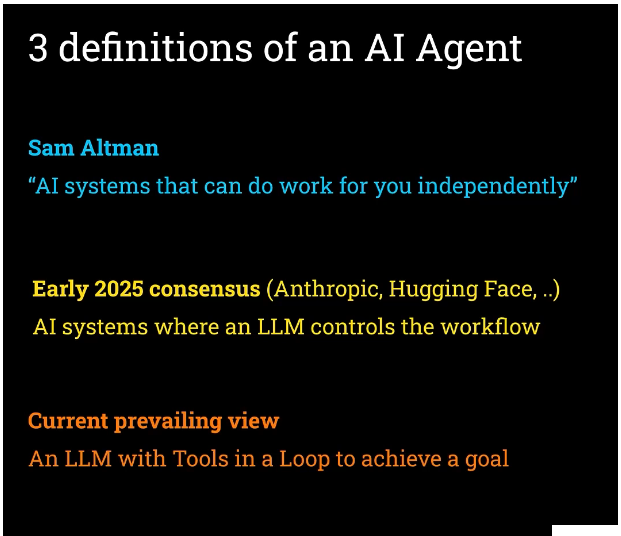
1. Sam Altman / OpenAI — the abstract version
"AI systems that can do work for you independently." This is the oldest and loosest of the three — a general sense that something is "off and running," doing work on your behalf. It ties back to OpenAI's Operator (later renamed ChatGPT Agent): give it a task like "find me a restaurant with availability tonight," and you watch it open a browser, search OpenTable, and act.
2. Early 2025 consensus (Anthropic, Hugging Face, …) — a tighter definition
"AI systems where an LLM controls the workflow." Instead of hard-coding "do A, then B, then C," you prompt an LLM with the options and let its output decide which branch your code takes. This is the first definition that gives you something concrete to test for.
3. Current prevailing view (credited to writer Simon Willison, late 2025)
An AI agent is an LLM with tools in a loop to achieve a goal.
This is the definition this course uses. It is the spine of the whole six-week track — the OpenAI Agents SDK, CrewAI, LangGraph and MCP are all just different ways of expressing the same loop.
The distinction that matters: an LLM call is not an agent
An LLM is a data science model. Give it a sequence of tokens, it returns the most likely tokens to follow. That is all it does — it cannot click a button, send an email, or take any action in the world.
What turns that into an agent is the code wrapped around it: code that takes the LLM's output tokens, interprets them, decides whether to call a tool, checks whether the goal has been reached, and loops back for another LLM call if not. When people say "the LLM decides what happens next," that is loose shorthand — what is actually happening is that your code is interpreting the LLM's tokens and acting on them.
Keep this mental model: the agent is the surrounding code that turns a vanilla LLM call into something that can act in a loop. This distinction gets more important, not less, as the frameworks in later weeks add layers on top of it.
Making it concrete: what you already built on Day 1
The n8n workflow from lecture 1.1 is an example of this third definition. It called an LLM (GPT) repeatedly, in a loop, and it had a tool (a Google Sheet) it could read and write from — and it kept going until it judged the goal accomplished. A drag-and-drop canvas and 200 lines of Python both express the exact same structure: an LLM, called in a loop, with tools, working toward a goal.
Agentic systems: workflows vs. agents
Anthropic's 2024 post "Building Effective Agents" is one of the most useful pieces of terminology in this space, and it is worth reading in full (linked below). It splits what it calls agentic systems into two styles — confusingly, both are "agentic," but only one of them is what most people mean by "an agent."
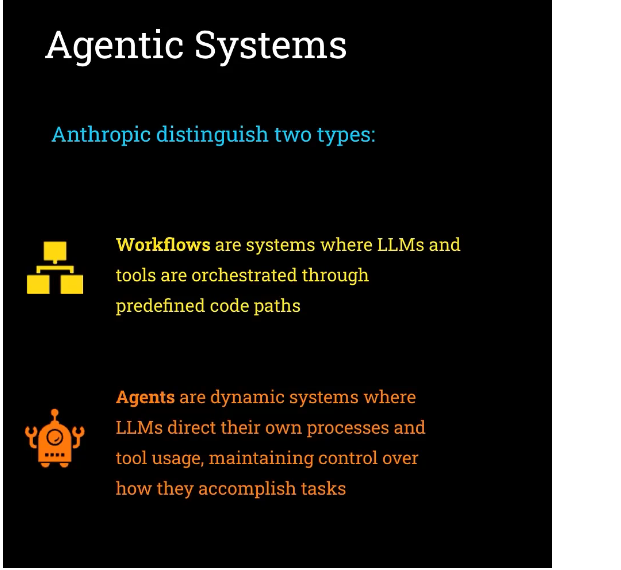
| Workflows | Agents |
|---|---|
| LLM calls chained together along predefined paths | LLM decides what happens next, open-endedly |
| Every path can be enumerated and tested in advance | Control flow is not fixed in advance — could even loop indefinitely |
| An LLM can still make a decision at one step (which branch to take) | The LLM has ongoing control over its own process, not just one branch choice |
Examples
- Workflow: "Deep Research" in ChatGPT/Claude — clarifying questions, then web searches, then a report, then a summary: a fixed sequence of stages.
- Agent: OpenAI's GPT Agent (formerly Operator) — opens a browser and works a task until done, with no predefined sequence of steps.
- Agent: Claude Code and other coding agents — open-ended, hammering away at a task until the LLM itself judges it complete.
You will build both styles in this course: a deep-research-style workflow in Week 2, and an open-ended agent ("Sidekick") in Week 4.
Real systems live in the gray area
Plenty of systems sit between the two — open-ended, but with some constraints (a maximum of five iterations, say). Anthropic's split is a useful way to talk about designs, not a strict box you must place every system into. And critically: Anthropic calls both styles "agentic systems." Building something as a workflow does not make it less agentic — it is a design choice.
In fact, for real commercial and production systems, workflows are very often preferred over open-ended agents, precisely because they are repeatable and every path can be tested in advance — even when an LLM is still making a decision somewhere inside that path.
What you should now understand
- There are three common definitions of "AI agent"; this course's working definition is an LLM with tools in a loop to achieve a goal.
- An LLM only ever generates tokens. The "agent" is the code that interprets those tokens and acts on them.
- Anthropic's two styles of agentic system: workflows (predefined, testable code paths) and agents (open-ended, LLM directs its own process).
- Both are "agentic systems" — workflow vs. agent is about how open-ended the control flow is, not about which one "really" counts.
- Production systems often favor workflows for testability, even though an LLM can still make decisions inside them.
Resource links
- Anthropic — "Building Effective Agents" (the source of the workflows-vs-agents split)
- OpenAI — Introducing Operator
- Hugging Face — smolagents: what is an agent?
- Simon Willison — writing on AI agents
- Course resources page
- This lecture on Udemy
Next
Lecture 1.10 — Agentic AI Design Patterns: Chaining, Routing, Orchestrator — builds directly on the workflow/agent split by naming the concrete patterns used to build both.